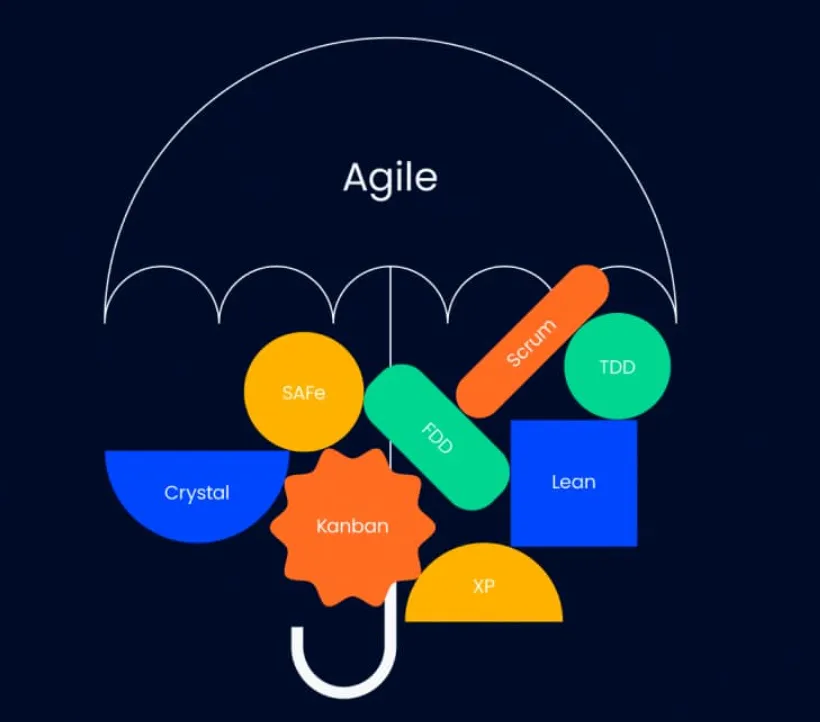
How Agile Methodologies Improve Python App Development Outcomes
In today’s boardroom conversations, the question is no longer whether to build digital products. But how to ensure they deliver measurable business outcomes. Speed alone isn’t enough. Neither is technical excellence in isolation. What leaders are ultimately accountable for is impact – faster time-to-market, lower risk, higher ROI, and products that evolve with customer demand.
This is where Agile methodologies, when applied to Python app development, shift the conversation from ‘building software’ to ‘delivering continuous business value.’
Why Traditional Models Fail: The Outcome Imperative
Executives across industries have seen the limitations of traditional development approaches. Long development cycles, delayed feedback loops, and rigid scope definitions often lead to products that are technically sound but commercially misaligned.
A McKinsey study found that only 30 percent of digital transformation initiatives achieve their intended outcomes, often due to poor alignment between business goals and execution. In software development, this gap becomes even more visible when applications fail to adapt to evolving market realities.
Python is inherently suited for rapid development and scalability. But without the right delivery framework, even Python app development initiatives can fall into the same trap – efficient execution of the wrong priorities.
Agile changes that equation – only when it is enforced as a business accountability framework, not just a delivery process.
Agile & Python: A Strategic Alignment
In enterprise environments, Agile fails when treated as a delivery ritual and succeeds only when enforced as a governance model for managing uncertainty and capital allocation.
Python’s strengths like speed, flexibility, and a vast ecosystem align naturally with iterative cycles of Agile methodology. The combination enables organizations to test assumptions quickly, validate business hypotheses, and pivot without incurring significant sunk costs.
For decision-makers, this blend delivers three essential outcomes:
- Faster realization of business value
- Reduced execution risk
- Continuous alignment with market demand
#1 Accelerated Time-to-Market Without Compromising Quality
Speed is often misunderstood. It’s not about coding faster. Instead, it’s about delivering meaningful value sooner.
Agile breaks large Python app development initiatives into smaller, outcome-driven increments. Each sprint is designed to deliver a working component that can be evaluated against business goals.
For example, instead of waiting 6 to 9 months for a full product launch, organizations can release a functional MVP in weeks, gather real-world feedback, and refine accordingly.
According to the State of Agile Report, companies that adopt Agile practices experience up to 30 to 50% faster time-to-market compared to traditional models.
In high-growth and transformation-led organizations, this typically translates into:
- Earlier revenue realization
- Faster competitive positioning
- Reduced opportunity cost
#2 Risk Mitigation Through Continuous Validation
One of the biggest risks in software investments is building something the market doesn’t need.
Agile mitigates this risk by embedding validation into every stage of development. In Python app development, where rapid prototyping is possible, this becomes even more powerful.
Each iteration becomes a checkpoint:
- Are we solving the right problem?
- Is the user experience aligned with expectations?
- Are we seeing early indicators of adoption?
This continuous feedback loop ensures that course corrections happen early, when they are least expensive.
A Harvard Business Review analysis highlights that projects using iterative development approaches reduce failure rates by up to 50%. For CFOs and CIOs, this directly impacts budget efficiency and capital allocation.
#3 Cost Optimization Through Incremental Investment
Agile transforms how organizations think about investment.
Instead of committing large budgets upfront, Agile enables phased investments aligned with validated outcomes. Python’s development efficiency further amplifies this advantage, reducing engineering effort and infrastructure overhead.
From a financial perspective:
- Costs are distributed across milestones
- ROI is measured continuously
- Underperforming initiatives can be controlled early
This approach is particularly valuable in uncertain markets, where flexibility in capital deployment is critical.
#4 Enhanced Stakeholder Visibility & Control
One of the most overlooked benefits of Agile is transparency.
Traditional development models often create a ‘black box’ effect, where stakeholders only see progress at major milestones. Agile eliminates this by providing continuous visibility into development progress, challenges, and outcomes.
For leadership teams, this means:
- Better decision-making based on real-time data
- Greater control over priorities
- Alignment across business and technology teams
In Python app development projects, where iterations are rapid, this visibility becomes a strategic advantage.
#5 Scalability & Future-Readiness
Modern applications are not static assets. They are evolving platforms.
Agile ensures that scalability is not an afterthought but an integral part of development. Python’s modular architecture and extensive frameworks (such as Django and Flask) make it easier to scale applications incrementally.
This is particularly important for organizations planning long-term digital initiatives:
- AI/ML integrations
- Data-driven decision systems
- Cloud-native architectures
Agile ensures that the foundation built today can adapt to tomorrow’s needs without requiring complete reengineering.
#6 Talent Utilization & Tactical Resource Allocation
Another critical dimension for executives is talent efficiency.
Agile environments empower teams to focus on high-impact tasks rather than rigid execution plans. When organizations choose to hire Python programmers, the expectation is not just technical proficiency but adaptability and problem-solving ability.
Agile frameworks enable:
- Cross-functional collaboration
- Faster onboarding of new talent
- Better alignment between business and engineering teams
This leads to higher productivity and improved morale, representing factors that directly influence project success.
#7 Customer-Centric Innovation at Scale
Ultimately, the success of any application depends on user adoption.
Agile places the customer at the center of development. Every feature, iteration, and release is evaluated based on its impact on the end user. In Python app development, this customer-centric approach is amplified by the ability to quickly test and deploy new features.
According to PwC, 73% of consumers say customer experience is a key factor in their purchasing decisions, yet only a fraction of companies deliver consistently.
Agile helps close this gap by ensuring that customer feedback is not just collected but acted upon continuously.
From Execution to Strategy: A Much Needed Shift
For decision-makers, Agile is not about managing development. It’s about managing outcomes.
When combined with Python’s capabilities, Agile becomes a strategic enabler for:
- Innovation
- Market responsiveness
- Sustainable growth
Organizations that recognize this are not just building applications. They are building competitive advantage.
Parting Thought
Agile methodologies improve Python app development outcomes because they keep every decision tied to business value, not just technical delivery. For leaders, this means faster releases, better budget control, reduced product risk, and stronger alignment between market needs and engineering execution.
Python gives organizations the speed and flexibility to build modern applications. Agile ensures that speed is directed toward the right outcomes. For organizations evaluating Python-led digital initiatives, this combination provides a lower-risk path to validate ROI early, control investment exposure, and scale only what proves value.
Whether you are building a customer-facing platform, internal workflow system, analytics application, or AI-enabled product, Agile-led Python development can help convert investment into measurable business impact.